
The Best Fluffy Pancakes recipe you will fall in love with. Full of tips and tricks to help you make the best pancakes.

Discovering the perfect mattress involves balancing comfort, support, and value. This article explores the innovative engineering behind modern compressible mattresses, focusing on multi-layer construction, durable edge support, and the science of pressure relief. We’ll analyze how features like independent springs and optimal thickness contribute to restorative sleep, supported by insights from sleep science and consumer experiences.
The Science of Layered Support: More Than Just Memory Foam
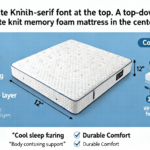
Modern mattress design, like that of the 12″ Independent Spring Mattress, relies on multi-layer construction to target different needs. A soft, conforming top layer eases pressure points, while a core of individually wrapped pocket springs provides zoned support. This hybrid approach is noted for its ability to minimize motion transfer, a key concern for couples. As discussed in a January 2022 Reddit thread on hybrid mattresses, users often report significantly less disturbance from a partner’s movements compared to traditional innerspring designs.
The principle of independent spring response is crucial. Each spring compresses independently, contouring to the body’s unique shape without creating a hammocking effect. This aligns with ergonomic research, which suggests targeted support helps maintain spinal alignment. The Wikipedia entry on mattresses details the evolution from continuous coil systems to pocketed springs, highlighting their benefit for personalized comfort and durability.
Engineering Durability: Edge Support and Optimal Thickness
Long-term value is defined by durability, a feature often overlooked. High-density foam reinforced along the perimeter, known as edge support technology, prevents the mattress from sagging at the sides. This expands the usable sleep surface and provides stability when sitting or sleeping near the edge. Without this reinforcement, mattresses can degrade quickly, leading to a feeling of “roll-off” and reduced structural integrity.
The specified 30cm (12-inch) scientific thickness is not arbitrary. This profile allows for a sufficient comfort layer while housing a substantial support core. A mattress that is too thin may lack pressure relief, while one excessively thick can hinder air circulation and feel overly rigid. The 30cm benchmark, as seen in the 30cm Scientific Thickness Mattress, aims to create a balanced feel that accommodates most sleeping positions—side, back, and stomach—by providing ample material to cradle the body and support the spine’s natural curve.
Convenience Meets Performance: Compression and Setup
The advent of compressible roll-pack technology has revolutionized mattress delivery. By vacuum-sealing and compressing the mattress into a manageable box, it solves logistical problems like navigating stairwells or small apartments. Once unboxed and unrolled, the mattress begins to aerate and expand to its full dimensions. This process leverages the elastic recovery of high-quality foam and does not compromise the material’s longevity, a common concern addressed by manufacturers’ warranties.
This convenience directly impacts the consumer experience, making premium sleep products more accessible. The ease of setup allows for immediate use, and the compact shipping reduces the product’s carbon footprint during transport. It represents a significant innovation from the traditional, cumbersome delivery of non-compressible mattresses.
Choosing Your Fit: Sizes and Ideal Use Cases
Selecting the correct size—Twin, Full, Queen, or King—is integral to maximizing sleep quality and room functionality. A Queen size is often considered the standard for couples, offering a balance of space and room footprint. For single adults or guest rooms, a Full provides ample space, while a Twin is ideal for children or compact spaces. The King size, offering generous width, is the pinnacle of personal sleep space, ideal for those who share a bed but desire maximum room.
Each size of the Balanced Support Every Day Mattress serves a distinct need, transforming spaces from primary bedrooms to guest suites. The right choice ensures the mattress’s supportive benefits—like pressure relief and spinal alignment—are enjoyed without compromise, making it a versatile solution for any household.
In summary, a high-quality compressible mattress represents a convergence of sleep science, material engineering, and consumer-centric design. The core benefits—hybrid layered support for minimized motion transfer and pressure relief, robust edge construction for durability, optimal 30cm thickness for balanced comfort, and compression packaging for effortless delivery—work in unison to provide exceptional value. As evidenced by discussions within sleep communities and the technical evolution of mattress design, these features are not mere marketing points but responses to documented sleep needs. Whether for a growing child, a guest room, or your own primary retreat, investing in a mattress with these engineered qualities promises to support not just your body, but your overall well-being for years to come. The result is a sleep solution that truly delivers on the promise of transforming nightly rest from a basic necessity into a consistently rejuvenating experience.



This article really highlights how important durable edge support is for maximizing usable sleep space.
\}}
This article really highlights how important durable edge support is for maximizing usable sleep space.
\}}
This article really highlights how important durable edge support is for maximizing usable sleep space.
\}}
This article really highlights how important durable edge support is for maximizing usable sleep space.
\}}
This article really highlights how important durable edge support is for maximizing usable sleep space.
\}}
This guide really helped me understand why edge support and that 30cm thickness are so crucial in a modern mattress.
\}}
This guide really helped me understand why edge support and that 30cm thickness are so crucial in a modern mattress.
\}}
This guide really helped me understand why edge support and that 30cm thickness are so crucial in a modern mattress.
\}}